
Defamation on Social Media: Can Reposting Be Illegal?
Can sharing a post expose you to legal action? Read our guide to defamation on social media reposting in Italy, with practical examples and next steps.
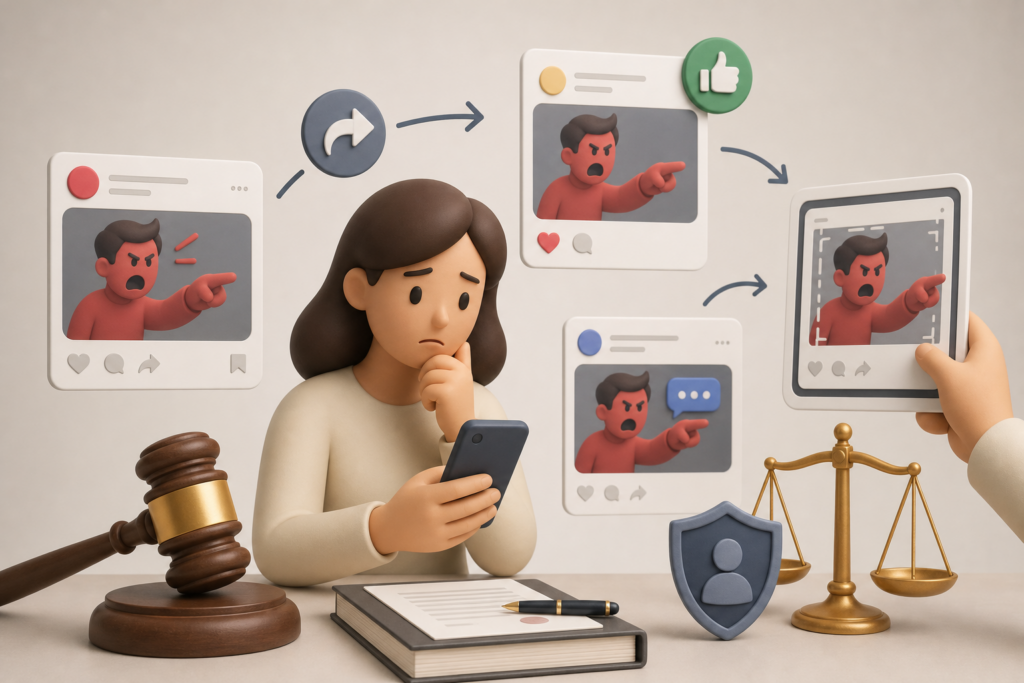
The key question in defamation on social media reposting cases is not simply who wrote the accusation first, but what each person communicated to others. Under Italian law, sharing someone else’s allegation can create a separate risk of liability. Adding an approving caption, forwarding it to a group or publishing a screenshot may matter just as much as writing the original post.
However, not every repost is defamatory. The wording, audience, context and purpose of the communication all matter. If someone has circulated an accusation about you, preserve each version before asking for removal: a repost may contain evidence that the original does not.
Defamation on social media reposting under Italian law
Article 595 of the Italian Criminal Code protects reputation against an offensive communication made to multiple people when the person concerned is absent from that communication. Online, the assessment is more nuanced than whether someone was tagged or could eventually read the post.
A lawyer assessing a repost will usually examine:
- Identification: can readers recognise the person or business, even without a full name?
- Reputational harm: does the message convey something damaging, rather than merely express disagreement?
- Communication: was it communicated to at least two other people, potentially at different times?
- Mental element: did the sharer knowingly communicate material whose reputation-damaging meaning they understood?
- Context and justification: could lawful reporting, criticism or another defence apply?
Public social media posts can fall within Article 595’s aggravated form involving a means of publicity. A restricted group is not automatically exempt from ordinary defamation, although the publicity aggravation requires a separate assessment.
A specific intention to ruin someone is not necessarily required. Equally, an inaccurate statement or an unverified share does not automatically establish every element of a criminal offence.
Scenario 1: the original accusation
The following scenarios are fictional illustrations, not reports of actual cases.
A customer posts in a neighbourhood group: “The owner of that repair shop steals customers’ belongings.” The shop is identifiable from an attached photograph, and several members read the post.
This is a concrete accusation of criminal behaviour, not simply a review saying that service was disappointing. If unsupported, it creates a substantial defamation risk for the original author.
Suppose the dispute actually concerns a missing accessory. Evidence of that dispute does not necessarily justify publicly calling the owner a thief. The difference between describing an experience and asserting deliberate criminal conduct matters.
For the targeted owner: save the complete post, photograph, account details, comments and URL. Keep the relevant service records too. Those records may help explain why the allegation is false or misleading, but they do not replace evidence of what was published.
Scenario 2: a repost with an approving caption
Another group member shares the accusation with: “Absolutely true. Avoid this thief.” They have no direct knowledge of the dispute.
The repost does more than point readers towards a discussion. It adopts the accusation and adds a fresh personal endorsement. The sharer may therefore face assessment for their own communication under Article 595, separately from the original author.
“I only shared it” is not a general defence. Nor does naming the original source automatically protect the person repeating the allegation. A new caption can strengthen the defamatory meaning, while distribution to another audience can extend its reach.
Even a repost without a caption may carry legal risk. Its meaning depends on how the platform presents it and the surrounding context; silence is neither automatic endorsement nor automatic protection.
For the person targeted, save both versions. Record the original author and the sharer separately, including publication dates and visible engagement. Do not assume a displayed share count proves how many people actually read the accusation.
Scenario 3: a screenshot shared to challenge the claim

A third person publishes a screenshot and writes: “This accusation is unsupported. Please stop circulating it.” Is that also defamation?
Clear distancing changes the assessment, but does not create blanket immunity. Readers should be able to understand immediately that the allegation is being challenged, not endorsed. A disclaimer buried below an inflammatory screenshot may be less effective than an explicit correction placed first.
Repeating the entire accusation, identifying the target and exposing it to a much larger audience may cause avoidable further harm. A lawyer would consider the overall message, its legitimate purpose and whether the details reproduced were necessary.
A lower-risk approach may be to summarise the issue without naming the target, obscure identifying details and avoid linking directly to the accusation. For example: “An unsupported theft allegation is circulating locally. Please do not share it.”
If you need legal advice, sending the unedited evidence confidentially to your lawyer is different from broadcasting it publicly. Keep an intact original even if you prepare a redacted version for another purpose.
Why context matters more than the share button
Italian defamation law must be balanced with freedom of expression. Reporting and criticism can be lawful when their legal conditions are met. Relevant considerations include the factual basis, public interest and manner of expression; criticism allows evaluative judgments but does not provide unrestricted permission to invent damaging facts.
Three details frequently change the analysis:
- Questions: “Is this owner a thief?” can still convey a damaging insinuation. A question mark is not a shield.
- Small audiences: a private group can satisfy the multiple-recipient requirement. “Private” does not mean legally harmless.
- Later corrections: deletion or an apology may help limit further harm, but does not automatically erase an offence already committed.
Assessment should cover the whole thread, not just one sentence cropped from it.
What to save before reporting a defamatory repost
Collect evidence before requesting removal, where doing so is safe. Content, captions and account names can change quickly.
- Capture the complete communication: include the accusation, caption, surrounding discussion and visible date.
- Record links and account identifiers: save the original post URL, repost URL and relevant profile links.
- Document your discovery: note when and how you found each publication.
- Preserve context: retain messages and documents relevant to the allegation, including material that complicates your account.
- Record actual consequences: keep cancellation messages or enquiries referring to the post, without assuming every business loss was caused by it.
Screenshots are useful, but their authenticity, completeness or attribution can be disputed. For serious or contested cases, ask a lawyer whether a more robust technical preservation process is appropriate. Do not enter private accounts or use someone else’s credentials to obtain evidence.
Removal, a querela and civil remedies
After preservation, report the content through the platform’s relevant process. Describe the specific accusation and your objection accurately. A platform report is not a criminal complaint, and refusal to remove content does not establish that it is lawful.
Defamation is generally prosecuted following a querela: the injured person’s formal request for prosecution. Under Article 124 c.p., the ordinary deadline is three months from acquiring knowledge of the offence. How that applies to separate reposts requires care. Do not assume continued availability restarts the clock, or wait to identify an anonymous author before seeking advice.
A lawyer can assess a querela to the police or public prosecutor, a removal request and possible civil relief. Article 2043 c.c. provides the general basis for compensation for wrongful harm; damages are not automatic and require appropriate support.
Get advice on the specific repost
Prepare the original post, each repost, discovery dates and a short factual timeline. Explain whether you want removal, protection against further circulation or advice about proceedings. This article provides general information, not personalised legal advice.
Submit your case and get a lawyer’s reply on the publications, evidence and deadlines relevant to your situation.
Frequently asked questions
Can I be liable for reposting a defamatory post without adding a comment?
Potentially, yes. A repost can communicate the allegation to others even without a caption. Liability depends on its meaning, audience, your awareness and any applicable justification; it is not automatic.
Does writing “allegedly” protect me when sharing an accusation?
No. Words such as “allegedly” or “unconfirmed” do not automatically neutralise a damaging accusation. The overall message and the conditions for lawful reporting or criticism still matter.
Can sharing a screenshot to defend someone be defamatory?
Context matters. A clear rebuttal differs from endorsement, but unnecessarily reproducing an identifiable accusation can create legal risk. Consider a non-identifying summary and preserve the original privately for legal advice.
Does deleting a repost prevent a defamation complaint?
Not necessarily. Deletion can reduce further circulation but does not automatically undo an offence already committed. Preserved screenshots and other evidence may still support a complaint.
How long do I have to file a querela over a defamatory repost in Italy?
The ordinary deadline is three months from acquiring knowledge of the offence. Separate reposts can require separate assessment. Reporting content to a platform does not pause the deadline, so seek advice promptly.
Did this happen to you?
Open a case: a lawyer calls you within 48 hours.