
Cyberstalking Laws Italy: Repeated Contact After Blocking
Cyberstalking laws italy repeated contact: learn when new accounts after blocking may breach Article 612-bis, what to save and when to seek help.
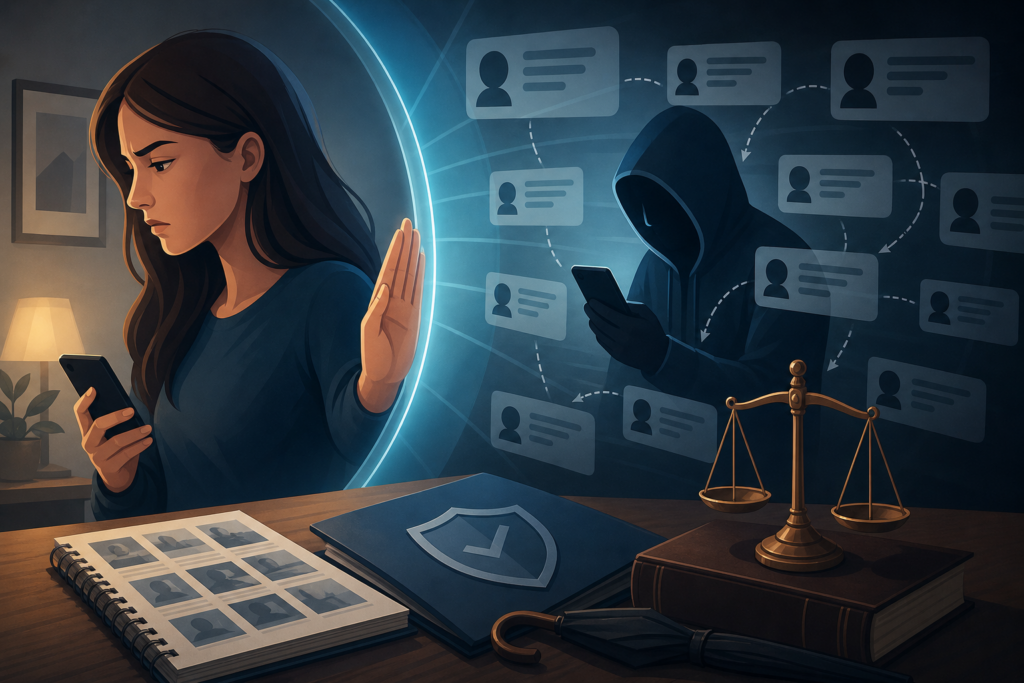
You block someone, and a new account appears: “You cannot ignore me forever.” Then another profile contacts your friends. If you are searching for cyberstalking laws Italy repeated contact, the key question is not simply how many accounts exist. It is whether repeated threatening or harassing conduct causes one of the serious consequences required by Italian law.
You do not have to keep replying to establish what is happening. Preserve what you can safely access, protect your accounts and seek help early. If you face immediate danger, call 112 rather than waiting for an online assessment.
When a blocked person keeps returning
Consider this fictional example. After ending a relationship, someone blocks their former partner. Over the following weeks, replacement accounts send demands for a conversation. Some messages sound apologetic; others mention the recipient’s workplace or movements. The sender also approaches mutual friends to get messages through.
The recipient starts avoiding their usual route home, fears leaving work alone and experiences persistent anxiety. Those details matter legally: the assessment concerns the whole pattern and its effects, not just whether one isolated message contains an explicit threat.
By contrast, a single unwelcome message from a replacement account does not automatically establish stalking. It may still justify a platform report, protective measures or legal advice, particularly if it contains threats.
Cyberstalking laws Italy repeated contact: the legal test
Article 612-bis of the Italian Criminal Code punishes repeated threats or harassment that cause at least one of three specified consequences. Online conduct can fall within this offence, known as atti persecutori; there is no requirement that the person also follow you physically.
The conduct must cause at least one of the following:
- A lasting and serious state of anxiety or fear. Ordinary irritation or temporary upset is not the same legal threshold.
- A well-founded fear for safety: your own, that of a close relative, or that of someone with whom you have an emotional relationship.
- A forced change in your daily habits. Examples may include changing routes, routines or social activities because of the conduct.
These are alternatives: all three do not have to occur. Repetition alone, however, is not enough. The authorities must assess the threatening or harassing conduct, its connection to the consequences and the surrounding circumstances.
There is no fixed message count that automatically makes contact criminal. Equally, you do not need to wait for dozens of messages before asking for help.
Why replacement accounts can matter
Creating a new account is not inherently unlawful. Using successive accounts to bypass blocks can, however, help demonstrate persistence and explain why the recipient feels unable to escape the contact.
Relevant details include:
- New accounts appearing shortly after earlier ones are blocked.
- References to previous conversations or information known to the suspected sender.
- Contact spreading across platforms, email addresses or messaging services.
- Messages sent to friends, relatives or colleagues to reach you indirectly.
- References to your location, threats, or pressure to meet in person.
A familiar writing style is a clue, not proof of identity. Record why you suspect a connection, but distinguish observed facts from assumptions. Account attribution may require investigative steps and platform-held information.
You are not required to send another “stop contacting me” message before seeking help. A previous refusal or block can provide useful context, but do not re-engage just to create evidence.
Save the pattern, not only the worst message
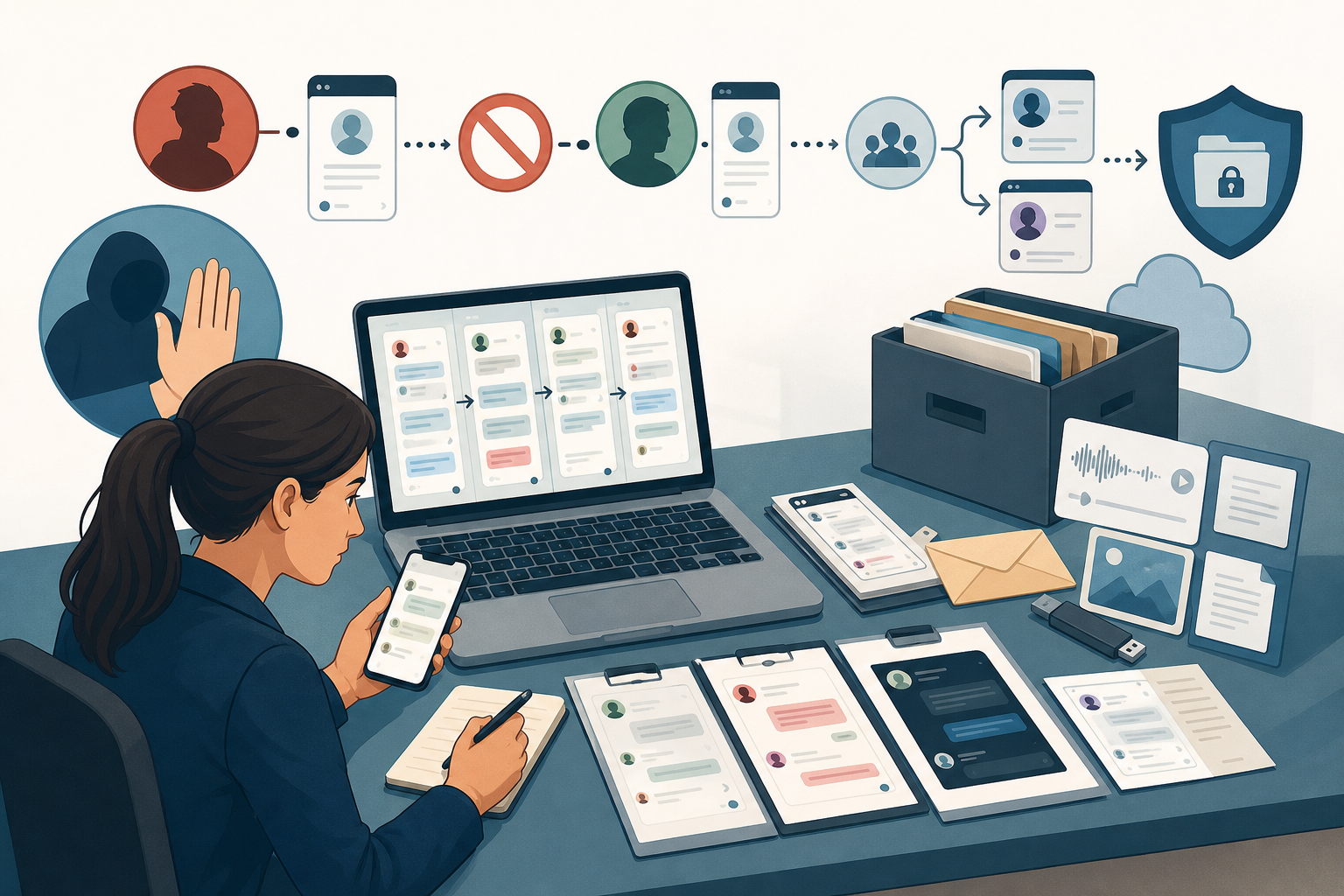
A screenshot of one frightening sentence may miss the repeated behaviour. Build a chronological record that a lawyer or investigator can follow without having to reconstruct everything from your phone.
- Capture each account. Save its username, display name, profile link and any visible account identifier.
- Preserve conversations with context. Include dates, times and surrounding messages. Keep original screenshots unchanged; use separate copies for annotations.
- Record the sequence. Note when you blocked an account, when another appeared and what linked the contacts.
- Retain available originals. Keep emails, voice messages, attachments and chat exports where the service allows them. Screenshots are useful, but authenticity and completeness can be disputed.
- Document consequences. Record disrupted sleep, missed activities, changed routines and people who witnessed your distress. Retain relevant medical records if you sought care.
- Save reporting confirmations. Keep platform acknowledgements and reference numbers alongside your evidence.
A useful entry might read: “14 June, 22:10: account B messaged me two hours after I blocked account A; it referred to the same private conversation.” Avoid presenting an inference as a confirmed identification.
Keep a secure backup outside any account the sender might access. Do not access their accounts, use tracking links or arrange a meeting to identify them. Your safety matters more than obtaining one more screenshot.
Reduce contact without increasing the risk
After preserving available evidence, report the profiles and messages through the platform’s harassment or safety tools. Explain that replacement accounts are bypassing blocks, and identify linked profiles where possible.
Then review practical safeguards:
- Restrict message requests, mentions, tags and visibility of your activity.
- Review active login sessions, change compromised passwords and enable two-factor authentication.
- Check location sharing, shared albums and connected devices.
- Ask trusted contacts not to disclose your whereabouts or relay messages.
Platform reporting and police reporting serve different purposes. Account removal does not resolve every safety risk, and it does not replace a criminal complaint. You do not have to leave an account unblocked to prove repetition.
Reporting in Italy and the six-month deadline
For stalking under Article 612-bis, the ordinary deadline to file a querela is six months from acquiring knowledge of the offence. Identifying the relevant starting point can be complicated when conduct unfolds over time. Do not assume each new message automatically restarts your deadline.
A querela is a formal request that the authorities prosecute. You can approach the Polizia di Stato, Carabinieri or the public prosecutor’s office; a lawyer can help present the chronology and explain the effects on your life. An unidentified sender does not prevent you from reporting.
Some cases are prosecuted without a querela, including specified situations involving minors or persons with disabilities and certain connected offences. Withdrawal is also subject to special rules. Obtain advice before assuming that a complaint can simply be cancelled.
Before a querela is filed, an ammonimento del questore, a formal police warning, may be available under Article 8 of Decree-Law 11/2009. It is not a mandatory first step or a substitute for emergency protection.
Possible consequences and protection
The basic penalty under Article 612-bis is imprisonment from one year to six years and six months, with increases in specified circumstances. Use of computer or telecommunications tools is expressly relevant to an increased penalty. The actual legal classification and sentence depend on the facts.
Where legal conditions are met, judicial protective measures may include restrictions on approaching or communicating with the person targeted. Neither a report nor screenshots automatically produce a protective order or conviction.
For women experiencing violence or stalking, Italy’s 1522 service offers support and guidance. For immediate danger, call 112.
Get your situation assessed
You do not need to decide alone whether the behaviour legally amounts to stalking. Prepare a short timeline, the account links, representative messages and an explanation of how the contact has affected your safety or routines.
This guide provides general information, not personalised legal advice. Upload only relevant material through the designated case-submission process, rather than posting sensitive evidence publicly. Submit your case and get a lawyer’s reply about your options under Italian law.
Frequently asked questions
Is making new accounts after I block someone automatically stalking in Italy?
No. Article 612-bis requires repeated threats or harassment causing serious, lasting anxiety or fear, a well-founded fear for safety, or a forced change in daily habits. Bypassing blocks can be important evidence of the overall pattern.
Can repeated messages count as stalking without explicit threats?
Yes. Repeated harassment can qualify even without explicit threats if it causes one of the consequences required by Article 612-bis. The content, frequency, context and effects must be assessed together.
Can I report replacement accounts if I cannot prove who owns them?
Yes. You can report an unidentified sender. Preserve profile links, messages and the reasons you suspect the accounts are connected, while separating facts from assumptions. Investigators may seek identifying information through lawful procedures.
Do I need a medical diagnosis to report cyberstalking?
No. A medical diagnosis is not a prerequisite for reporting. Relevant medical records can help, but messages, witness accounts and evidence of changed routines may also support an assessment of the consequences.
Does reporting an account to a platform stop the querela deadline?
No. A platform report does not suspend or replace the criminal complaint deadline. For stalking, the ordinary querela deadline is six months from knowledge of the offence, with special rules and exceptions requiring case-specific advice.
Did this happen to you?
Open a case: a lawyer calls you within 48 hours.