
Doxxing: What to Do When Your Workplace Is Published
Searching for doxxing what to do workplace published? Learn how to protect yourself, alert your employer discreetly and seek removal under Italian law.

If someone has published your workplace alongside hostile messages, the priority is your safety—not arguing with the account. Searches such as doxxing what to do workplace published often follow a frightening discovery: strangers now know where to find you. Even if your employer’s address was already public, linking it to threats or encouraging people to approach you can change the risk significantly.
This guide explains practical first steps in Italy: alerting your employer discreetly, preserving evidence, requesting removal and checking what else has been exposed. You do not need to determine the correct legal offence before seeking help.
Doxxing: what to do when your workplace is published
If someone threatens to come to your workplace, appears nearby or describes an imminent attack, call 112. Tell the operator your location, the wording of the threat and whether the person may already be present. Do not delay an emergency call to collect screenshots.
For a concerning post without an immediate threat:
- Save the post’s link and a quick screenshot, if safe.
- Tell one appropriate workplace contact before strangers contact or visit the premises.
- Avoid replying publicly or confirming your shift, entrance or current location.
- Report the content and preserve the report reference.
- Contact police promptly if there are threats, repeated targeting or attempts to approach you.
A named employee, an exact shift and “go teach them a lesson” deserve particular attention. A public business address alone does not establish the same level of danger. Describe the actual conduct rather than relying only on the label “doxxing.”
Alert your employer without spreading the information
Choose a manager, HR contact or security lead who can act discreetly. If that person is involved in the abuse, use an alternative reporting route. Ask for the information to remain limited to staff who need it for safety.
A short private message can say:
Someone has posted my workplace online alongside hostile messages. I am concerned about unwanted calls or visits. Please do not confirm my attendance, schedule or contact details to external callers. Could we agree on a contact person and a procedure if anyone asks for me?
Send the relevant evidence privately rather than forwarding the post to a whole team. Agree on practical measures: reception should not confirm whether you are present, unexpected visitors should follow normal access checks, and suspicious calls should be logged.
Depending on the circumstances, discuss a temporary change of entrance, shift or working arrangement. These are options to assess, not guaranteed entitlements. Ask colleagues not to confront the poster or publicly defend you in ways that reveal more information.
Preserve threats and their connection to your workplace
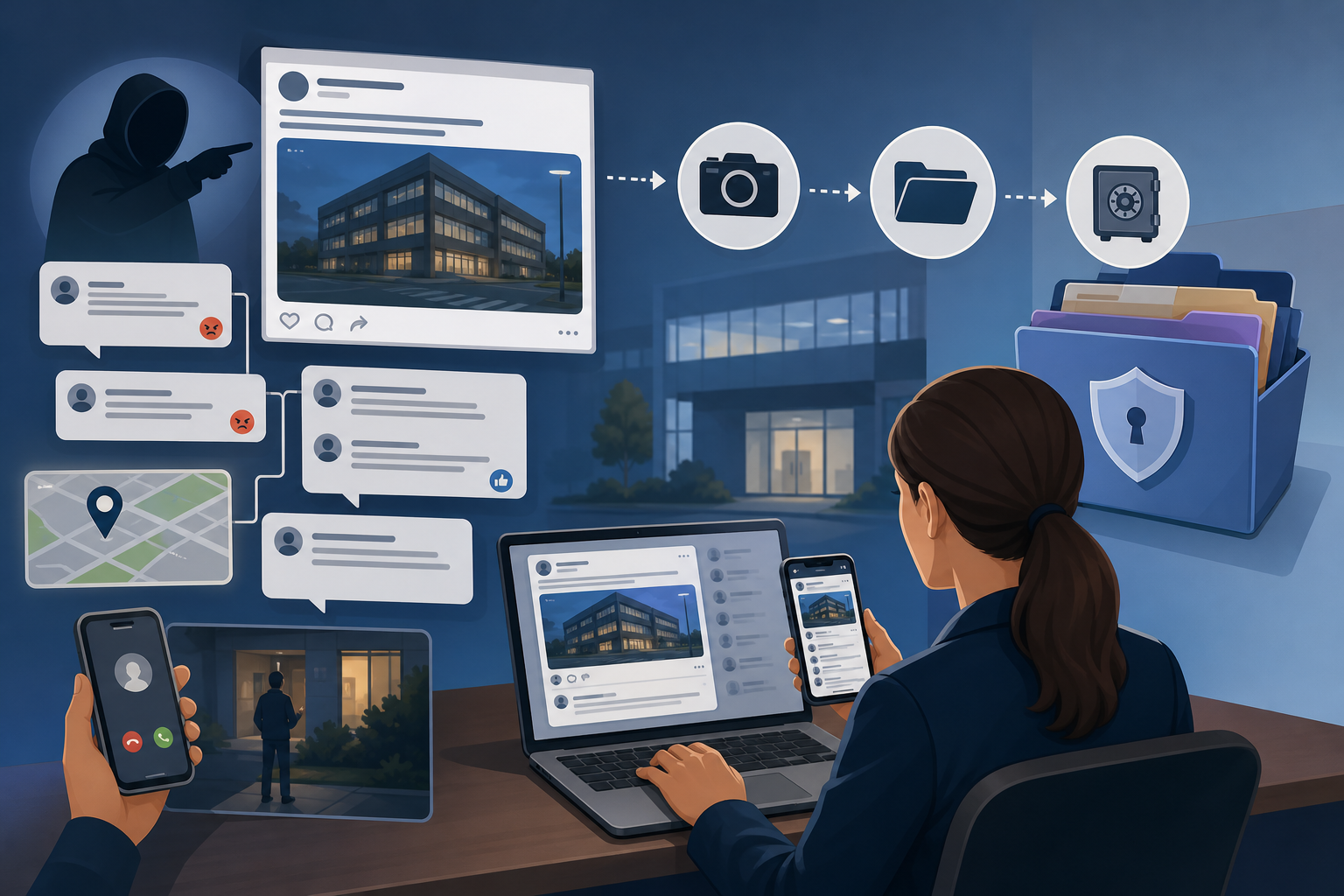
Capture enough context to show who posted the information, what they said and how others responded. A cropped screenshot of an address may miss the threatening caption that makes the exposure significant.
- Content: save the full post, caption, relevant comments and surrounding conversation.
- Identifiers: record the account handle, profile URL and individual post links.
- Timing: note when you discovered it and any visible publication time.
- Escalation: preserve messages mentioning visits, shifts, entrances or calls to your employer.
- Workplace incidents: record unwanted calls or visits, witnesses and any incident reference.
Keep originals unedited and backed up securely. Use separate copies for highlighting or redaction. For disappearing content, a screen recording may help show the profile and sequence, but no capture method automatically guarantees evidential weight.
Ask your employer to preserve relevant incident logs or existing CCTV footage through its authorised procedures before routine deletion. Do not access restricted systems or obtain someone else’s account data yourself. A lawyer can assess whether a more formal preservation method is proportionate.
Request removal of the post and identifying details
Use the platform’s most relevant reporting route: threats, harassment, disclosure of personal information or privacy violations. Report the original post and threatening replies separately where necessary. Save acknowledgement emails and decision notices.
Explain the connection between the information and the danger:
This post identifies my workplace and encourages people to approach me there. The accompanying message says “[exact wording].” I have not consented to this targeting. Please assess the post and linked replies under your personal-information, harassment and threat policies.
Use only claims supported by the content. If the address is publicly available, say so rather than describing it as confidential; explain how it is being used to target you. Public availability does not automatically make every reuse lawful or acceptable under platform rules.
If a report is rejected, use any available review process and identify the overlooked threat or personal detail. Search-engine removal is a separate request: removing a result does not delete the source page. Avoid contacting the poster directly if doing so could escalate matters.
Which Italian laws may apply to workplace doxxing?
Italian law does not treat every publication of workplace information as one automatic offence called “doxxing.” The wording, purpose, repetition and consequences matter.
- Threats — Article 612 c.p.: threatening another person with unjust harm can constitute a criminal offence, including through online messages.
- Stalking — Article 612-bis c.p.: repeated threats or harassment may qualify when they cause serious and persistent anxiety or fear, a well-founded fear for safety, or force changes to everyday habits.
- Defamation — Article 595 c.p.: communications to multiple people that damage an absent person’s reputation may constitute defamation; posting a workplace address alone does not necessarily meet those conditions.
- Data protection — GDPR: where the rules apply, identifying employment information can be personal data, and Article 17 may support an erasure request, subject to conditions and exceptions.
For example, posting “this person steals from customers” beside their workplace and inviting others to wait outside may raise several distinct concerns. A lawyer should assess each part rather than assuming that one offence covers everything.
Where appropriate, a privacy complaint can also be submitted to Italy’s data protection authority, the Garante. Privacy procedures do not replace emergency assistance or a criminal complaint.
Report promptly and ask about querela deadlines
You can approach the Polizia di Stato or Carabinieri, including the Polizia Postale for online conduct. Bring a short chronology, links, screenshots and details of workplace incidents. You can report an unknown account holder; you do not need to identify them yourself first.
A querela expresses the injured person’s wish for criminal proceedings where the law requires it. The general deadline is three months from knowledge of the offence; stalking generally has a six-month deadline. Exceptions and circumstances requiring prosecution without a querela can apply, so obtain advice promptly.
A platform report does not replace a querela or stop its deadline. Tell police clearly that you want to understand whether a formal querela is needed, rather than assuming an informal account of events completes the process.
Review what else the post exposes
Search your name, public usernames and workplace together. Check biographies, old CVs, tagged photographs, public calendars and images showing badges or entrances. Avoid uploading private information to unfamiliar “doxxing check” services.
Remove unnecessary shift and location details from accounts you control. Ask colleagues not to tag your live location, restrict unwanted messages and enable two-factor authentication. Keep a simple log of new incidents instead of repeatedly monitoring the account alone.
This guide provides general information, not personalised legal advice. For an individual assessment, prepare the threatening content, relevant links, discovery dates and a brief explanation of any workplace contact. Share only necessary information through the case submission process, not in public comments.
Submit your case and get a lawyer’s reply. Explain that your workplace has been published and flag any threats or approaching deadlines. If danger is immediate, call 112 first.
Frequently asked questions
Is publishing my workplace online illegal in Italy?
Not automatically. The assessment depends on the context, accompanying messages, purpose and applicable privacy rules. Threats, repeated harassment or defamatory allegations can create separate legal issues even when the workplace address is public.
Should I tell my employer if nobody has contacted the workplace yet?
If the post encourages unwanted contact or includes threats, a discreet warning can help staff respond safely. Tell an appropriate manager, HR contact or security lead and ask them not to disclose your schedule or presence.
Can I report doxxing if the account is anonymous?
Yes. Preserve the account handle, profile URL, post links and messages, and explain that the author is unknown. Identification may require investigative steps and is not guaranteed.
Should I block the account immediately?
Blocking can reduce direct contact. If safe, preserve relevant content and account details first because blocking may make them harder to access. Do not keep contact open if doing so puts you at risk.
What if the platform refuses to remove my workplace address?
Request review if available and explain how the address is linked to threats or targeted harassment. Preserve the refusal. A lawyer can assess privacy requests, a complaint to the Garante or other remedies; removal is not guaranteed.
Did this happen to you?
Open a case: a lawyer calls you within 48 hours.