
Fake Negative Reviews From a Competitor: What to Save
Looking for fake negative reviews competitor evidence? Learn what to save, how to document suspicious patterns and why they do not prove who posted them.
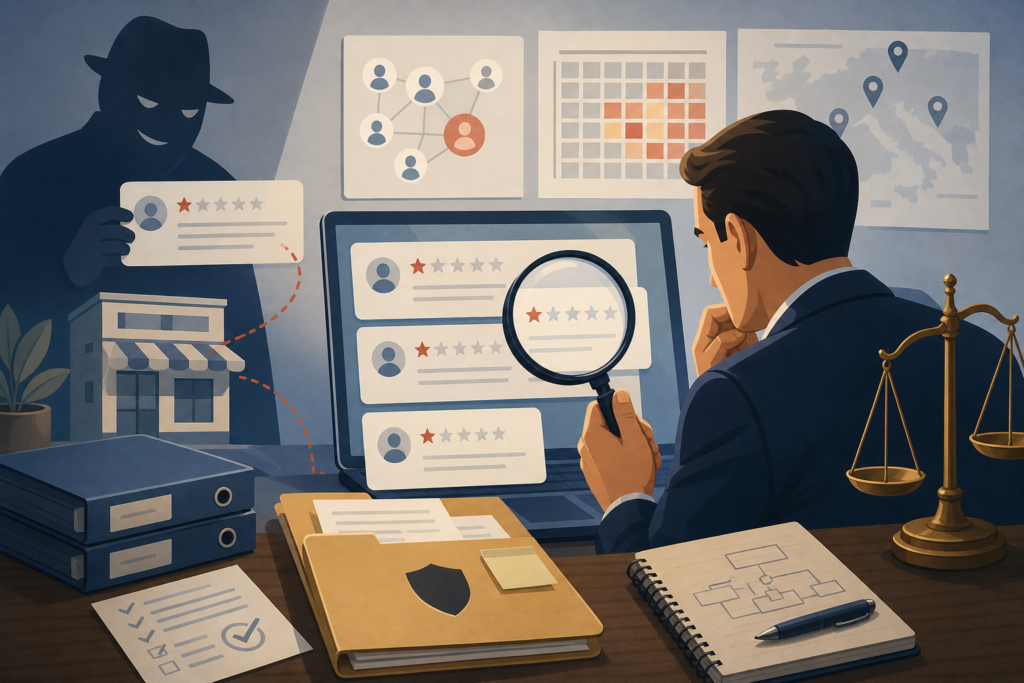
If you searched for fake negative reviews competitor after receiving several suspicious ratings, start by preserving evidence—not accusing a rival. Review timing, repeated wording and reviewer histories can reveal useful patterns, but they do not establish who wrote or commissioned the posts.
Under Italian law, the content of a review and evidence connecting it to a competitor are separate questions. This checklist explains what to save, how to compare reviews with customer records, and what a lawyer needs to assess possible defamation or unfair competition.
1. Fake negative reviews competitor evidence: separate facts from suspicion
Build your evidence file around three distinct questions:
- What was published? Preserve the exact review, rating, account details and surrounding context.
- What makes it inaccurate or suspicious? Identify specific claims contradicted by records, unusual timing or repeated language.
- What connects it to a competitor? Record identifiable links without treating assumptions as established facts.
For example, five reviews appearing after a rival opens nearby may justify investigation. That timing alone does not prove involvement. A genuine customer could post under a nickname, while an account promoting another business may have no relationship with its owner.
Use neutral labels such as “unmatched customer record” or “identical wording.” Avoid naming your folder “proof that the competitor attacked us” when attribution remains uncertain.
2. Save the reviews and the patterns around them

The complete review and its location
Capture each review before reporting it. Save the full text, star rating, displayed reviewer name, publication date, any visible edit information and your business listing. Include business replies and relevant context.
- Copy the direct review link where available, plus the listing URL.
- Take uncropped screenshots showing enough context to identify the page.
- Record when you captured the material, including the time zone.
- Keep original image files and any platform notification emails.
If text is hidden behind “read more,” expand it. A screen recording can show navigation from the listing to the review and reviewer profile. Screenshots are useful, but they do not automatically establish authenticity or authorship; disputed material may require additional technical preservation.
Timing and sequence
Create a timeline with separate entries for publication, discovery, capture, edits and removal. Do not convert a relative label such as “two days ago” into a supposedly exact publication time.
Note objectively verifiable events: a genuine customer dispute, a promotional launch or a sudden cluster of ratings. Preserve review notifications if they help narrow the timeline. Explain what the timing suggests without presenting coincidence as causation.
Repeated wording and factual errors
Save reviews containing identical sentences, unusual spelling mistakes or the same incorrect description of your services. Quote the matching passages side by side in a separate comparison document, keeping the originals untouched.
A cluster describing a treatment your salon has never offered is worth documenting. However, copied wording can come from templates, imitation or a shared source; it does not identify the author.
Public reviewer histories
Capture publicly visible profile links, contribution counts and relevant review histories. Useful observations include several accounts praising the same rival or reviewing the same businesses in an unusual sequence.
Record only what is visible. A profile with one review is not necessarily newly created, and a display name is not verified identity. Do not use deceptive accounts, seek private login details or publish dossiers about suspected reviewers.
3. Compare claims with customer records carefully
Check the alleged visit, purchase or booking against records you lawfully hold. Relevant material may include appointment logs, invoices, order histories, service descriptions and customer correspondence.
Document the search method: which date range you checked, which identifiers you used and what you found. “No matching booking under this display name” is more accurate than “this person was never a customer.”
Consider walk-ins, purchases booked by relatives, shared orders and transactions made under another name. A review can also concern a genuine interaction that produced no sale.
If a reviewer alleges a Sunday appointment and your business was closed, preserve the opening schedule and relevant booking records. That contradiction is useful, but a mistaken date remains possible. Keep originals securely and redact unrelated customer information from copies used for platform reports.
4. Preserve links to a competitor without overstating them
Potentially stronger attribution evidence includes a message acknowledging involvement, correspondence threatening a review campaign, or reliable material connecting a reviewer account with a competing business.
Save the complete conversation, not just the incriminating sentence. Preserve sender details, dates and email headers where available. If someone witnessed an instruction to post fake reviews, record their contact details and what they personally observed; do not coach their account.
A profile photograph, similar username or favourable review of a rival is only a lead. Accounts can be impersonated, shared or compromised.
Platforms may hold account or access data, but you cannot assume they will disclose it directly to you. A lawyer can assess whether appropriate preservation or disclosure steps are available. Neither identification nor continued availability of technical records is guaranteed.
5. Understand which Italian legal rules may apply
Article 595 of the Italian Criminal Code concerns injury to another person’s reputation communicated to multiple people in the offended person’s absence; public online reviews may fall within its aggravated form involving a means of publicity.
A negative review is not automatically criminal defamation. Courts consider its wording, factual basis, context and the limits of lawful criticism. “I disliked the service” differs from a fabricated allegation that a business falsifies invoices.
Article 2598 of the Italian Civil Code addresses unfair competition, including business-discrediting statements and conduct contrary to professional fairness where the required competitive relationship exists. A review campaign attributable to a rival may raise these issues, but an anonymous hostile review does not by itself establish competitor liability.
Article 2043 of the Italian Civil Code provides a general basis for compensation for wrongful harm. Preserve evidence of specific losses, such as cancellation messages referring to the reviews; a rating drop alone does not establish a particular damages amount.
6. Report the reviews without losing your evidence
After preservation, use the platform’s current reporting process. On Google or Trustpilot, select the policy reason supported by your evidence and explain the specific discrepancy. Keep report references, submissions and responses.
A platform report is not a criminal complaint and does not suspend legal deadlines. For ordinary defamation, the Italian querela deadline is generally three months from knowledge of the offence under Article 124 of the Criminal Code. Ask a lawyer promptly how that rule applies; do not assume anonymity or continued online availability extends your time.
If you reply publicly, stay factual: “We cannot identify this experience from the information provided. Please contact us privately so we can investigate.” Avoid exposing customer information or publicly accusing a competitor.
7. Prepare a focused file for a lawyer
Organise your submission into original captures, a dated timeline, customer-record checks, possible attribution evidence and documented business impact. Include a short summary separating confirmed facts from unanswered questions.
Do not delay seeking advice until you have identified the author. Provide relevant material through the designated case-submission process, avoid unnecessary third-party personal data, and retain your originals.
This guide provides general information, not personalised legal advice. Submit your case and get a lawyer’s reply about the evidence you have and the options that may fit your situation.
Frequently asked questions
Can I prove a competitor posted fake reviews from repeated wording?
Repeated wording can support suspicion of coordination, but it does not prove who wrote or commissioned the reviews. Preserve the matching text alongside any independent evidence linking the accounts or campaign to the competitor.
Is a review fake if I cannot find the reviewer in my customer records?
Not necessarily. Reviewers may use nicknames, visit without booking or purchase through someone else. Record which records you checked and describe the result as an unmatched record rather than proof that no interaction occurred.
Are screenshots enough for an Italian defamation complaint?
Screenshots can be useful evidence, but their weight depends on context and any challenge to authenticity. Preserve complete captures, links, dates, original files and supporting records. A lawyer can advise whether additional technical preservation is appropriate.
Can I file a querela without knowing who wrote the review?
Yes, a querela can be filed against an unknown author. Supply the review links, account details and preserved evidence. Identification is not guaranteed, and you should not wait for a name before asking about the filing deadline.
Will reporting a review to Google or Trustpilot pause the querela deadline?
No. Platform reporting and an Italian criminal complaint are separate processes. The ordinary defamation querela deadline is generally three months from knowledge of the offence; obtain advice on the starting date in your case.
Should I publicly name the competitor I suspect?
Avoid public accusations based on patterns alone. An unsupported allegation may create legal risks and complicate your case. Preserve the evidence and discuss attribution with a lawyer before confronting or naming anyone.
Did this happen to you?
Open a case: a lawyer calls you within 48 hours.