
Remove Fake Google Reviews: When Your Report Is Rejected
Trying to remove fake Google reviews after a rejected report? Learn how to match policies, strengthen evidence and check appeal options for your business.
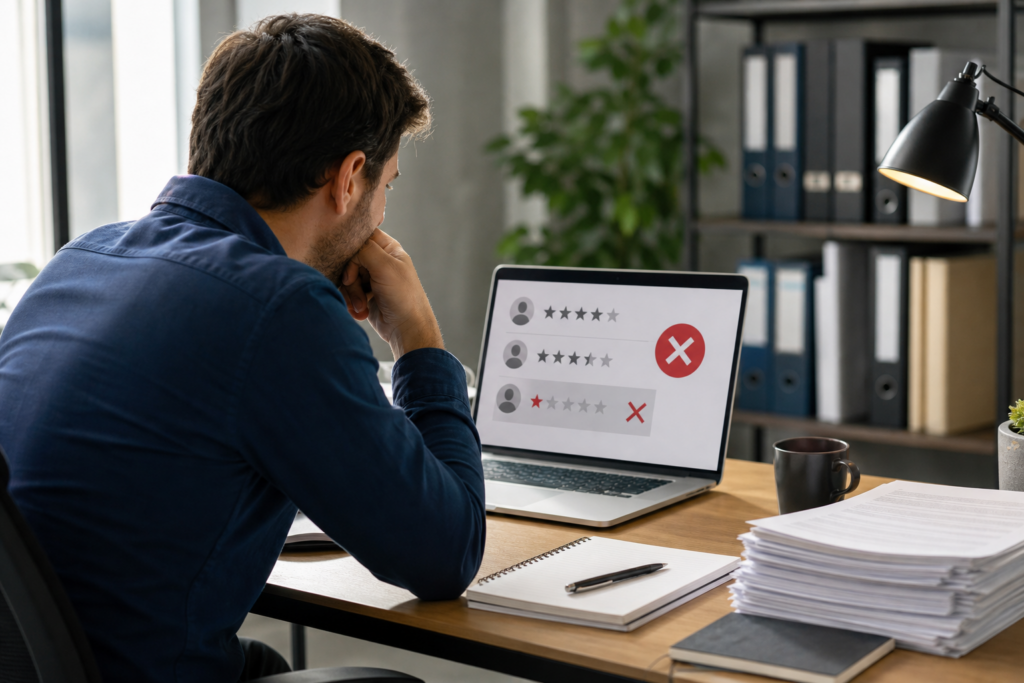
If you tried to remove fake Google reviews and your report was rejected, do not simply submit the same complaint again. First establish what Google decided, which policy the review may breach and what evidence supports that breach. A removal refusal does not establish that the review is true—or that it is lawful under Italian law.
This guide explains how businesses in Italy can troubleshoot a rejected report, check available appeal options and recognise when a separate legal assessment may be appropriate.
1. Check whether Google actually rejected your report
Open the Reviews Management Tool through Google’s official guidance on reporting inappropriate reviews, using an account associated with your Business Profile. Check the review’s status and any notification you received.
- Pending: Google has not yet completed its assessment.
- No policy violation found: the initial report was unsuccessful; check whether an appeal is offered.
- Escalated or under appeal: an additional assessment may already be underway.
Exact status labels and available options can change. Save the decision email, case reference and a screenshot of the status. If the review is missing from the tool, check that you selected the correct business location and account before assuming it was rejected.
2. To remove fake Google reviews, identify the policy breach
Google does not remove a review merely because a business disputes it. Compare the content with its Maps prohibited and restricted content policies. Select the strongest relevant ground rather than alleging every possible violation.
Fake engagement or conflicts of interest
A review that does not reflect a genuine experience may fall under fake engagement. A review posted to undermine a competitor, or arising from an employment or other professional conflict, may engage conflict-of-interest rules. These grounds need supporting facts: an unfamiliar display name alone proves neither.
Harassment, personal information or offensive content
Threats, prohibited personal information and certain abusive content may justify reporting independently of whether the author was a customer. Quote the precise offending passage and explain the applicable rule. Do not classify every harsh criticism as harassment.
Off-topic content or advertising
A political rant unrelated to the business or a promotional message directing readers elsewhere may fit another policy category. However, a complaint about booking, communication or customer service can concern a genuine experience even without a completed purchase.
3. Separate a fake review from a negative opinion
“We have no customer with that name” is a useful lead, not decisive evidence. Reviewers may use aliases, accompany someone else or interact with a business before buying anything.
Consider these hypothetical examples:
- “The receptionist was rude when I called.” No invoice is expected. Disagreement with the account does not establish fabrication.
- “They installed my kitchen last Tuesday.” If your business only repairs bicycles, the mismatch supports a focused report, although mistaken identity remains possible.
- “The owner steals customers’ deposits.” This alleges misconduct rather than merely expressing dissatisfaction. Preserve it for potential legal assessment as well as policy review.
A genuine customer’s review can contain unlawful allegations, while a fabricated rating may breach platform rules without making an identifiable defamatory allegation. Keep those questions separate.
4. Build an evidence pack that answers the rejection

An appeal should make the alleged breach easy to verify. Prepare a short chronology and organise the following:
- The review itself: full text, rating, displayed date, reviewer profile link and direct review link where available.
- Context: screenshots showing the business listing and surrounding information, not just a cropped sentence.
- The decision: report date, selected reason, response and any case reference.
- Supporting material: relevant booking records, correspondence or service information showing a specific contradiction.
- Patterns: dated examples of identical wording across unrelated listings or a cluster of suspicious reviews.
Preserve original files and record when you captured them. Screenshots can be useful evidence, but they do not automatically establish authorship or authenticity. For serious or rapidly changing content, ask a lawyer whether stronger preservation measures are appropriate.
Share only necessary information with Google. Redact unrelated customer details and avoid uploading entire customer databases. Describe suspected competitor involvement as a suspicion unless reliable evidence establishes the connection.
5. Use the available appeal, not repeated identical reports
Google’s Reviews Management Tool may offer a one-time appeal for eligible rejected reviews. Follow the current prompts: eligibility and the information you can submit depend on the review’s status and the available workflow.
Keep your explanation factual and concise. A useful structure is:
I request reconsideration of review [link], reported on [date]. The relevant policy is [policy category]. The review states [short quotation]. This conflicts with [specific verifiable fact]. Supporting material shows [brief explanation]. Please assess this policy issue rather than treating the submission solely as disagreement with a negative opinion.
For example, a business could explain that the review describes a service it has never offered, identifying the relevant service information and attaching a dated enquiry in which the reviewer acknowledges contacting the wrong business.
If no appeal appears, follow the help route offered in the tool or decision notice. A support enquiry may help clarify status or technical problems; it does not guarantee another substantive review. Avoid repeated identical reports or asking unrelated people to mass-report the review.
6. Distinguish Google’s decision from your Italian legal options
A policy appeal and a legal complaint serve different purposes. Google assesses platform rules; a lawyer assesses whether the facts support legal action and which procedure fits.
Article 595 of the Italian Criminal Code concerns injury to someone’s reputation communicated to multiple people in the offended person’s absence; a publicly accessible online review may involve the aggravated form associated with a means of publicity. Not every offensive review meets the requirements, and lawful criticism must also be considered.
Article 2598 of the Italian Civil Code addresses unfair competition, including discrediting statements about a competitor’s business where the necessary competitive relationship and other legal conditions exist. An unexplained negative review alone does not prove competitor involvement.
Civil remedies may also be relevant, but compensation requires a supported claim: a low rating does not automatically establish financial loss. Preserve cancellation messages and other evidence linking the publication to identifiable harm.
For ordinary defamation, the deadline to file a querela is generally three months from learning of the offence; its precise starting point needs case-specific assessment. Reporting to Google does not suspend that deadline. You do not necessarily need to identify an anonymous author before seeking legal advice or filing against an unknown person.
7. Check separate legal and EU redress routes
If you believe the content is unlawful, check Google’s separate legal-removal process through its Legal Help Center. Explain the specific allegedly unlawful statement and legal basis. A legal notice is not simply another attempt at the same policy appeal.
For users and decisions within its scope, the EU Digital Services Act provides complaint and redress mechanisms, potentially including certified out-of-court dispute settlement. Check the decision notice and current eligibility requirements. These routes do not guarantee removal and should not distract from an approaching Italian legal deadline.
8. Protect your business while the review remains online
If you respond publicly, keep it brief: “We cannot identify the experience described from the information provided. Please contact us privately so we can investigate.” Do not disclose customer records, accuse an unverified competitor or threaten the reviewer.
DefameStop can help you put the facts before a lawyer. Include the review link, screenshots, Google’s rejection, your discovery date and any evidence supporting your concerns, limiting unnecessary personal information. This guide is general information, not personalised legal advice.
Submit your case through DefameStop and get a lawyer’s reply on the options appropriate to your evidence and deadlines.
Frequently asked questions
Why did Google reject my fake review report?
Google may not have identified a policy violation from the review and available information. Saying that the reviewer is not in your customer records may be insufficient, especially if they used an alias or contacted the business without making a purchase.
Can I appeal Google’s refusal to remove a review?
Eligible rejected reviews may have a one-time appeal option in the Reviews Management Tool. Check the current status and prompts, then explain the specific policy breach with relevant evidence. Not every decision has the same appeal options.
Can Google remove a fake one-star rating with no text?
A rating without text can still breach rules on fake engagement or conflicts of interest. However, the absence of written allegations makes supporting evidence particularly important. A low score alone is not a policy violation.
Does a rejected report mean the review is legal in Italy?
No. Google’s policy decision does not determine whether Italian law has been breached. A lawyer can separately assess potential defamation, unfair competition or other grounds using the publication and supporting evidence.
Should I wait for Google’s appeal before filing a querela?
Do not let the platform process cause you to miss a legal deadline. The ordinary defamation querela deadline is generally three months from learning of the offence, and a Google report does not suspend it. Obtain advice about the precise starting point.
Can a lawyer guarantee that a fake review will be removed?
No. A lawyer can assess the evidence, prepare appropriate notices and explain available remedies, but cannot guarantee Google’s decision, identification of an anonymous reviewer, compensation or a court outcome.
Did this happen to you?
Open a case: a lawyer calls you within 48 hours.